
Some trips give you a great story. This one gave Sue and me something closer to a great silence, the kind that stays with you long after you have driven home. If you have read my About page, you already know Sue and I have a habit of finding adventure together. On June 11th, we left on a road trip across North Dakota and into Wyoming, eventually bound for Bozeman, Montana, to see my daughter Erica. Along the way, visiting sacred Native American sites became the unexpected heart of our trip. We did not fully understand what either place meant until we were standing alongside them. This post is not a typical Mindfully Minnesotan adventure recap. There is no face-plant in the mud here, no popped ankle, no punchline. What follows is my honest attempt to share what we saw and learned, with as much respect as I can offer for places that belong, first and always, to the people for whom they are sacred.
Bear Lodge: The Name Behind Devil’s Tower
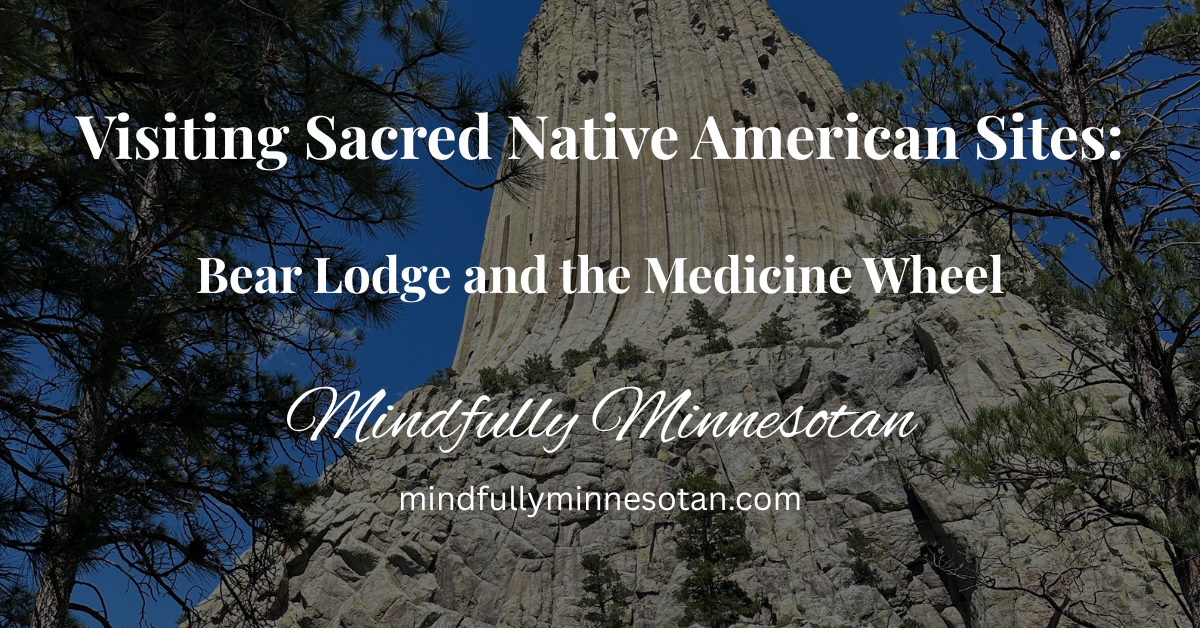
We arrived at Devil’s Tower National Monument on Friday, June 12th. Before we even reached the base of the tower, I learned something that changed how I saw the rest of the day. The name ‘Devil’s Tower’ is not the original name. Most of the tribes connected to this place would not choose it.
In Lakota, the formation is called Mato Tipila, which translates to Bear Lodge. The Arapaho, Cheyenne, Crow, and Kiowa each have their own names for it, and nearly all of them reference a bear. In 1875, an Army colonel named Richard Irving Dodge led an expedition to the site. Historians believe his interpreter mistranslated the native name as ‘Bad God’s Tower,’ which Dodge then shortened to ‘Devil’s Tower. People still debate whether it was an honest mistake or something more deliberate, but the name stuck. It became the country’s first national monument in 1906, and the name has remained ever since, despite ongoing requests from tribal nations to officially rename it Bear Lodge.

A Name That Still Sits Wrong With Me
I found this part genuinely fascinating to learn, and also a little maddening if I am honest. A name change back to Bear Lodge requires an act of Congress or a Presidential Proclamation, not a simple correction. Therefore, I do not fully understand the resistance to giving this place back its original name. It feels like the least we could do.
Visiting Sacred Native American Sites Starts With Paying Attention
Before we even started the loop trail, we noticed the climber registration booth had no attendant. Because climbers must register before heading up the tower the closed booth caught my attention right away. People around us were talking about how there were no climbers on the tower that day, which struck me as unusual given how popular Devil’s Tower is with rock climbers. I did not think much of it at the time.
Walking the loop trail around the base, the next thing Sue and I noticed was the prayer cloths. Someone had tied them to tree branches all the way around the tower, some clearly old and weathered, others new and bright. Some were tobacco bundles. There was a small kiosk along the trail that explained what they were and asked visitors not to touch them. We did not touch them, did not photograph them closely, and tried to walk past them the way you would walk past someone praying in a church.
About halfway around the loop, I noticed the energy felt scrambled. At first, I chalked it up to the number of people milling around. Then, I noticed birds everywhere, circling and diving near the upper part of the tower. A little further along, a sign explained part of it: rangers had closed several climbing routes for nesting falcons. That explained the birds. However, looking back, I remembered seeing the climber registration booth was closed before we even started, which now made a lot more sense.

The Ranger Who Stayed to Talk
About two-thirds of the way around the tower, where you can see the old wooden climbing ladder built into the rock, we spotted two climbers resting on a ledge. Meanwhile, Sue and I overheard a young park ranger explaining to another visitor that climbing is discouraged during the month of June. We thought that was interesting, and as we walked away, we started asking each other why. So, I turned around. The ranger was still there, so we went back and asked him directly.
He explained that June is one of the most sacred and spiritually significant months for the Native American tribes connected to this place, largely because of the summer solstice. Many ceremonies take place here during June, and many tribal members believe that climbers on the tower can interfere with their prayers reaching the spirits above. Although the National Park Service cannot legally prohibit climbing, what they can do, and what they ask, is that climbers voluntarily choose not to climb during this month out of respect. This voluntary closure has been in place since 1995, and it came directly out of an agreement between climbing organizations and the tribes who consider this site sacred.
Because the ranger could see how genuinely interested Sue and I were, he asked if he could show us something. We said absolutely. He took off his backpack and pulled out his own personal notebook, full of research he had done on Devil’s Tower and the Black Hills on his own time. For about fifteen minutes, it was just the three of us standing there while he shared what he had learned.
What the Stars Taught the Lakota
He told us that the Lakota have their own set of constellations, distinct from the Greek and Roman constellations most of us grew up learning, though some overlap in the stars they use. The Lakota tracked the seasons by watching which constellation the sun appeared to move through, and that knowledge directed where they traveled and which ceremonies they performed. One of those constellations, Mato Tipila or Bear Lodge, uses the same stars we know as Gemini. When the sun moved into Bear Lodge, roughly corresponding to the weeks around the summer solstice, it was time to gather at the tower itself for ceremony. The shape of the constellation is said to mirror the shape of the tower on the ground below it, a reflection between sky and earth that has been mapped and studied by groups like the Native Skywatchers project.

The Great Race and the Magpie
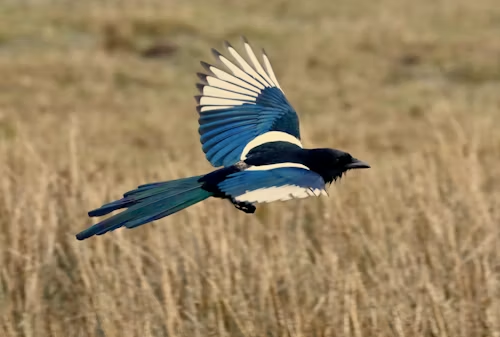
He also told us a version of what people often call the Great Race, a Lakota story tied to the red clay ring that circles the Black Hills. In it, the four-legged animals and the two-legged people once raced around the entire Black Hills to decide who would have power over the other. Nearly every animal sided with the buffalo, except for a handful of birds, among them a magpie. As the story goes, the buffalo ran far ahead for most of the race, but the magpie, slow and unassuming as it was, came from behind and crossed the finish line first by the smallest of margins. Because of her unlikely courage, the Lakota have honored the magpie ever since. Some say the red clay ring that circles the Black Hills marks the path of that race.
A Gift, Not a Coincidence
Sue and I both left that conversation with the same feeling. It seemed like more than coincidence that we circled back at the exact moment we did, and that this particular ranger, carrying his own notebook of research, happened to be standing there. Call it energy, call it spirit, call it luck. We choose to call it a gift.
Leaving Bear Lodge
We left Devil’s Tower with a real sense of awe, and honestly, a sense of how small we are. We drove roughly 145 miles to Bear Lodge Resort in Burgess Junction, taking US-14 across the Bighorn Mountains. If you ever have the chance to drive that stretch of road, take it. It is genuinely one of the most beautiful drives either of us has done.
It was not until later that I realized what we had done. We left Bear Lodge, the tower itself, and drove straight to a place called Bear Lodge Resort to spend the night. Coincidence or not, it felt like something.
That same night, around 3 a.m., the weather turned. Rain came first, then the temperature dropped to a balmy 32 degrees, and it began to snow. We woke up to about five inches on the ground. In June.

Preparing to Visit a Sacred Site Means Bringing an Offering
Before this trip, I had only been to the Bighorn Medicine Wheel once before, just a few years earlier, almost by accident. I was driving across US-14 leaving Cody, Wyoming, with my husband Dennis when we stumbled upon it. That visit left enough of a mark on me that I knew, when planning this trip with Sue, I wanted to bring her there too.
The night before, while we were still in Bismarck, North Dakota, I looked up what an appropriate offering would look like at the Medicine Wheel. Friends of mine connected to the John Beargrease Sled Dog Marathon, many of whom are Native American, had taught me years ago that if you are going to ask the spirits for something, you should not show up empty handed. As a result, we took a short detour into Dickinson, North Dakota, to find organic loose leaf tobacco. We also picked up cloth and string to make a small prayer bundle. Sue felt the same way I did about it. Neither of us wanted to be rude to the spirits of that place.
What the Medicine Wheel Is
The Medicine Wheel National Historic Landmark sits at roughly 9,640 feet near the summit of Medicine Mountain in the Bighorn National Forest. Researchers believe the wheel itself is very old, with age estimates ranging from a few hundred years to more than 3,000 years, and oral histories from the tribes connected to it trace the surrounding area’s cultural significance back over 10,000 years. The U.S. Forest Service jointly manages it with a group of tribal nations and historical organizations working together under a formal preservation agreement. It is not a commercial site. There are no vendors, no gift shop at the wheel itself, no paid tours. You simply go, and going there means going with respect.

Visitor Protocol for Anyone Visiting Sacred Native American Sites
Before you go, it is worth knowing the protocol. Walk to the left, which means clockwise, around the wheel. Dogs must remain on a leash at all times and are not permitted on the path immediately surrounding the Medicine Wheel itself. Additionally, photography is not allowed if a ceremony is taking place. If you arrive and a ceremony is in progress, the expectation is to observe quietly from a distance rather than approach. Prayer offerings left at the site should never be touched. Visitors are also asked to stay on the established walking paths to help protect the fragile natural and archaeological resources around the wheel.

The Drive Up Medicine Mountain
It was a 22-mile drive from Bear Lodge Resort to the trailhead. On the way, we counted five moose and two separate elk herds, which alone would have made the morning memorable. The final stretch to the trailhead is a narrow, winding dirt road climbing up the mountain, and after the snow overnight, it was completely covered. We were the first car on that road that morning.

The Hike In
We reached the first gate, about a half mile before the actual trailhead. For most visitors, it is a 1.5 mile hike in from there, though visitors with disabilities are permitted to drive closer. Because of where we parked, our hike in ended up being closer to two miles, all of it over slippery, snow-covered, clay-like mud. Being completely alone on that mountain, I will admit I spent part of the hike wondering if I was about to become cougar or bear bait. It is a real concern in that country, and worth being prepared for if you make this hike yourself.


Standing at the Wheel
The Medicine Wheel itself is about 80 feet across, built from local white limestone. It has 28 spokes radiating out from a central cairn, with several smaller cairns spaced around its rim. Sue and I had the wheel completely to ourselves. As we walked, sometimes we could see the valley stretched out below us. Other times, the clouds rolled in and closed it off entirely.
I had my reservations going into this hike, if I am honest. Between the difficult drive up and the unexpected snow, I wondered for a moment if we should turn back. But I had talked about this place to Sue for so long. She had trusted me enough to come all this way for it. I was not going to let her down.
My Prayer at the Wheel
I made it about halfway around the wheel before something told me to stop. I was facing the inner spokes, saying my prayer, when the sun broke through the clouds and peeked out for the first time that morning. It rose directly behind me as I spoke. That is the only reason I believe I was standing on the eastern side of the wheel, based on where the sun came up at my back. Afterward, I left my offering there and continued slowly around the rest of the wheel, just observing.
At one point, in my mind, I saw eagles. I do not know exactly what that meant, but I have wondered since if they were simply carrying my prayer the rest of the way for me.

Leaving the Wheel
I left the wheel with an overwhelming sense of warmth, calm, gratitude, and something close to disbelief. I have now been fortunate enough to stand at the Medicine Wheel twice in my life, both times with only one other person beside me. The first time was with Dennis. This time, it was Sue. After she finished her own prayer, we walked one final loop around the wheel together, each of us pointing out small details the other had noticed, surprised by how differently we had each experienced the same place. As we were finishing, another couple was just arriving at the wheel, the first people we had seen all morning.
What Visiting Sacred Native American Sites Taught Me
Devil’s Tower is genuinely magnificent, and I do not want to take anything away from it. But it is also crowded, and that crowd, however well meaning, creates a kind of static. For those of us who are attuned to energy, it was hard to fully settle into stillness there with so many people moving around the base. The Medicine Wheel, on the other hand, was the opposite. There was no static. Just Sue, the mountain, and a quiet I am still not sure I have the right words for.
I do not think it is my place to explain the full spiritual meaning of either site. That belongs to the tribes for whom these places are sacred, and I would rather point you toward their own words than try to speak for them. What I can offer instead is this. If you are interested in visiting sacred Native American sites of your own, go slowly. Read the signs. Ask questions if a ranger seems willing to talk. Bring an offering if it feels right to you, and bring humility regardless. These are not roadside attractions. They are still living, breathing places of prayer, and we were lucky enough to be allowed to walk through them quietly for a little while.
From there, Sue and I pointed the car toward Bozeman, Montana, where my daughter Erica was waiting for us, and the next chapter of this trip began — whitewater rafting the Gallatin River with Montana Whitewater, hiking the stunning trails around Hyalite Reservoir, and exploring the Middle Cottonwood Trail where we had an encounter with a rubber boa constrictor we will never forget.


Leave a Reply