
Last weekend, my friend Sue and I went foraging for wild edibles on Minneosta’s North Shore at the North House Folk School in Grand Marais. The class was called Foraging for Spring Wild Edibles and I had been trying to get into it for three years. This year, I finally vowed to get registered. The class was taught by Ian Andrus, a local resident, and was only offered once a year to a limited number of students. As a result, spots are limited and the class is very popular.
My Friend Sue
When I was thinking about backpacking the Border Route Trail, I asked myself, “Who do I know that is adventurous enough to think about doing this hike with me? And crazy enough to actually do it?” Sue came to mind immediately. So I called her and, without hesitation, she blurted out YES! The funny thing is, Sue had never backpacked before — but she was all in. I’ll tell you more about that adventure later.
Anyhow, Sue is the kind of all-in person who simply cannot resist a class like this. Additionally, Sue is an educator herself. For the past 33 years, she has taught physical education. I wish I would have had Sue as a gym teacher when I was younger because I totally see her as the cool teacher — not the crabby Balbricker-Porky’s gym teachers I always seemed to get. During the summer months, she loves to garden. More recently, she has been learning about the healing powers of plants and herbs and making tinctures. We joke about all the bottles of vodka she has sitting in her basement. Needless to say, this class was right up her alley.
North House Folk School: A Hidden Gem in Grand Marais
If you know, you know. If you don’t, you really need to — because you are missing out. Big time! The North House Folk School is a treasure that sits in the arrowhead region on the shore of Lake Superior in Grand Marais, one of the best small towns in Minnesota. The North House is one of my favorite non-profit organizations and I have personally taken seven classes there. All of them were terrific. I have had the opportunity to meet personally with the Director of Development and was impressed to learn what an extensive vetting process they have for their instructors. Since inception in 1997, the North House has grown to offering over 350 classes and 3,000 students annually. It is the perfect place to learn about foraging for wild edibles on Minnesota’s North Shore.

Preparing for the Class: What to Wear and Bring
Cook County in May can mean many things: cold, wind, rain, snow, sleet, mild, ticks, mosquitoes, black flies, sun — you get the drift. Basically, pack it all! I checked the weather and the highs were in the low 50s, so I knew long pants were in order. Moreover, a puffy coat for the morning session was a must.
Sadly, northern Minnesota is fast becoming a mecca for tick-borne diseases. In order to protect myself, I unapologetically turn into a walking nuclear waste facility. I spray my shoes and clothes with Permethrin and I have my DEET ready like a six-shooter at a moment’s notice. Nothing beats good old fashioned DEET and a solid health insurance plan.
I also equipped myself with a new basket for collecting. Before I took the class, I had downloaded the PictureThis app on my phone — highly recommend it for plant identification. After taking the class, I also purchased two excellent books:
- The Forager’s Harvest: A Guide to Identifying, Harvesting, and Preparing Edible Wild Plants by Samuel Thayer
- Field Guide to Edible Wild Plants of Eastern and Central North America by Samuel Thayer
Introductions: The Morning Begins at the Fishhouse
The morning started with gathering in the yellow building, where all the instructors introduced themselves along with the classes they were teaching. Afterwards, North House staff introduced themselves and gave a rundown of the campus activities. Following that, we went to our classrooms. Ours was the kitchen.
The Fishhouse is the building on campus that houses the commercial kitchen. We gathered there first for a short classroom session on foraging. We discussed sustainable harvesting — take only what you need. Better yet, take less. We discussed identification methods and the absolute need to be certain. The bottom line: hope is not a strategy when identifying wild edibles. Eventually, we split into three cars and headed out for the morning trek.
The First Forage: Foraging for Wilding Edibles on the North Shore
We drove to our first spot. It was out of town. In the woods. That’s all I’m going to say — you have to take the class to get the actual location! We walked just a little ways off the Superior Hiking Trail — another hint, I’m nice like that!
Ostrich Fern (Matteuccia struthiopteris)
Also known as fiddleheads, Ostrich Fern is identifiable by its grooved, celery-like stem and a coppery paper sheathing. It is one of the most popular edible ferns in North America.
- Nutritional benefits: Rich in antioxidants, omega-3 and omega-6 fatty acids, iron, and potassium. A good source of vitamins A and C.
- How to eat it: Always cook before eating. Boil or sauté — never eat raw.

Stinging Nettle (Urtica dioica)
We also picked Stinging Nettle, which shocked me to no end. I have been cussing these things out for 25 years. I wish I had known I could have gotten my sweet revenge by eating them!
- Nutritional benefits: One of the most nutrient-dense wild plants available. High in vitamins A, C, K, and several B vitamins. Also rich in calcium, iron, magnesium, and phosphorus. Contains all essential amino acids.
- How to eat it: Boiling neutralizes the sting completely. Use like spinach or steep for tea.

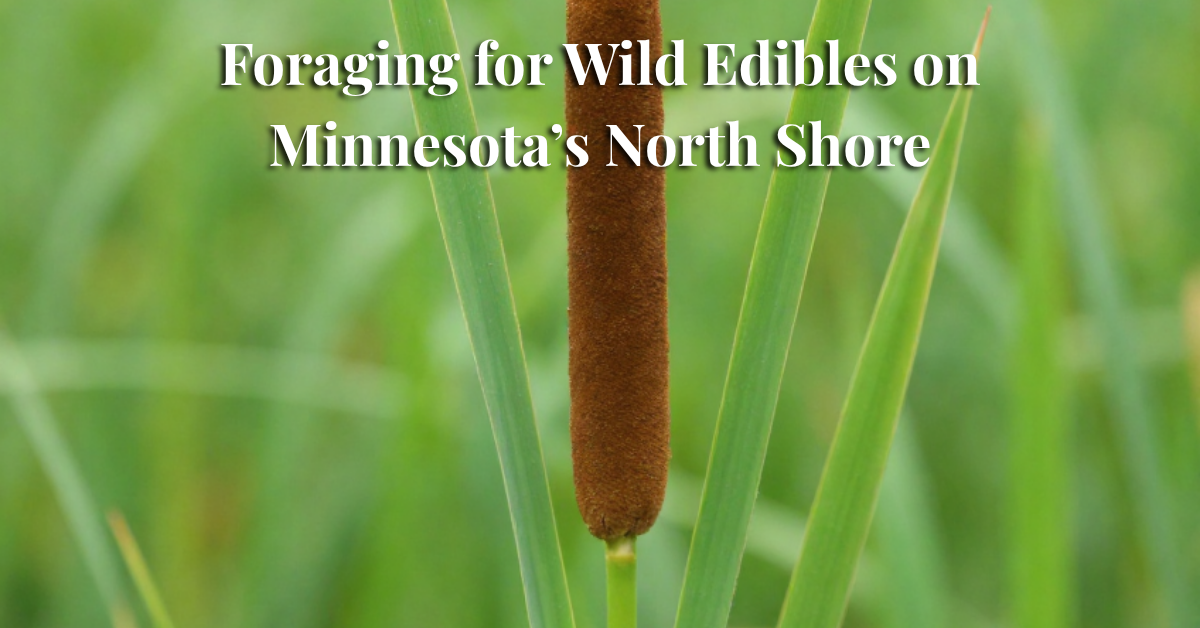
Cattail Shoots (Typha latifolia)
Spring arrived late on the North Shore this year, so there were only a few small cattails to find. We peeled the outer green leaves from the shoots until we reached the tender inner core, then boiled them. Everyone seemed to love it. I thought it was meh — it reminded me of very thin fettuccini.
- Nutritional benefits: High in starch, protein, and carbohydrates. Contains vitamins B1, B2, and C as well as potassium and phosphorus.
- How to eat it: Boil the shoots, roast, or eat raw when very young. Tastes similar to corn.
Preparing the Edibles: Back at the Fishhouse Kitchen
Once back at the Fishhouse kitchen, we cut up the Ostrich Ferns and Stinging Nettle and proceeded to boil them in separate pots. The stinging nettles were fabulous boiled. We added a little butter and a pinch of salt and it was like eating spinach but with an earthier flavor. Additionally, we saved the cooking water and drank it as tea.
The ostrich ferns were boiled and eaten plain first, to get a feel for them. They reminded us of asparagus. Finally, they were sautéed in a little butter — and that was good too. Overall, our haul in the woods was a success. We cleaned up and then broke for lunch.
The Second Forage: An Afternoon of Discovery
After lunch, we met back at the Fishhouse to discuss our final destination. We drove about 30 minutes to another unnamed location.
Wintercress (Barbarea vulgaris)
The first raw wild edible we were able to try. Wintercress is part of the mustard family and has a peppery, slightly bitter flavor.
- Nutritional benefits: High in vitamins C and K. Contains glucosinolates studied for anti-cancer properties. Also a source of calcium and iron.
- How to eat it: Eat raw in salads or lightly cooked. Best harvested before it flowers.

Wild Ramps (Allium tricoccum)
From there, we walked through the woods to a patch of wild ramps. You can eat the entire plant. However, it is best not to — because they are extremely slow growing. Best practice is to leave the bulbs intact and only eat the leaves, which taste like chive.
- Nutritional benefits: Rich in vitamins A and C, selenium, and chromium. Contain powerful antioxidants studied for cardiovascular and immune benefits.
- How to eat it: Raw in salads, sautéed, in soups, or as a substitute for garlic or onion.

Lamb’s Quarter (Chenopodium album)
Often considered a weed, lamb’s quarter is actually one of the most nutritious wild greens available.
- Nutritional benefits: Extremely high in vitamins A, C, and K. Rich in calcium, iron, and protein. Some studies suggest higher nutritional content than spinach.
- How to eat it: Use raw in salads or cooked like spinach.

Thistle (Cirsium spp.)
Yes — you can eat those prickly suckers! This one surprised everyone in our group.
- Nutritional benefits: High in fiber, vitamins C and B12, and minerals including magnesium and potassium.
- How to eat it: Remove spines first. Stems can be peeled and eaten raw or cooked. Roots can be roasted.
Ox Eye Daisy (Leucanthemum vulgare)
We tried Ox Eye Daisy, which tastes like licorice with a splash of pepper — what a surprise!
- Nutritional benefits: Contains flavonoids and essential oils. Traditionally used for anti-inflammatory properties.
- How to eat it: Young leaves and flowers can be eaten raw in salads.
Chickweed (Stellaria media)
We tried chickweed, which tastes like cornsilk — delicate and mild.
- Nutritional benefits: High in vitamins C, A, and B vitamins. Also contains iron, calcium, and magnesium. Known for anti-inflammatory properties.
- How to eat it: Eat raw in salads or lightly sauté. Best harvested young.

Wood Sorrel (Oxalis acetosella)
Wood sorrel has a bright, lemony flavor that is quite pleasant.
- Nutritional benefits: Contains vitamin C and oxalic acid. Best consumed in small quantities due to oxalate content.
- How to eat it: Use sparingly raw in salads for a citrusy note.
Burdock (Arctium lappa)
A well known edible plant widely used in Asian cuisine.
- Nutritional benefits: Good source of fiber, folate, vitamins B6 and C, potassium, and manganese. Known for prebiotic properties that support gut health.
- How to eat it: Peel and cook the roots like a vegetable. Young leaves can also be eaten.

Yellow Dock (Rumex crispus)
Last but certainly not least, we identified yellow dock.
- Nutritional benefits: High in iron, traditionally used to support anemia. Also contains vitamins A and C and tannins with antioxidant properties.
- How to eat it: Young leaves can be cooked like spinach. Cook in multiple changes of water to reduce bitterness.

Would I Recommend This Class? Absolutely.
In general, I thought the class was excellent and well worth my time. It was a small, intimate group and by the end of the day we were joking around with each other and having a great time interacting with Ian. Overall, the class was well worth my time and money and I would definitely recommend it to anyone interested in learning to forage for wild edibles on Minnesota’s North Shore.
My One Critique
I should mention that there were eight of us in the class and apparently two or three others were registered but did not show — which is unfortunate. He said every session there are usually one or two no-shows. This is horribly unfortunate because there is always a wait-list for people wanting to get into the class.
Pro tip: Become a member of North House now and be sure to register for the class the day registration opens this coming winter for next spring’s class. Don’t be the person on the wait-list for three years like I was!
Essential Foraging Tools & Resources
These are the exact tools and books I use and recommend:
- PictureThis App — Plant identification made easy
- The Forager’s Harvest by Samuel Thayer
- Field Guide to Edible Wild Plants of Eastern and Central North America by Samuel Thayer
- Permethrin Clothing Treatment — Tick protection
- Foraging Basket
Have you ever tried foraging for wild edibles on Minnesota’s North Shore? I’d love to hear about your experience in the comments below!


Leave a Reply