
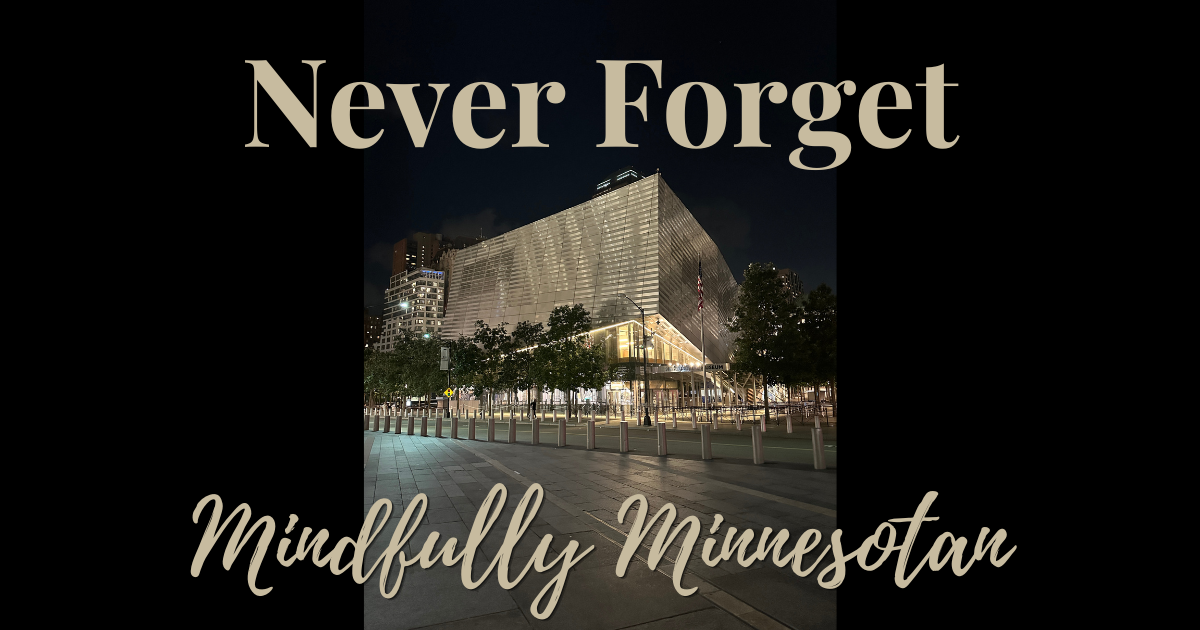
My Dedication
This post is dedicated to those who lost their lives on September 11th, 2001: to the people in the World Trade Center towers, to the people at the Pentagon, and to the passengers and crew of Flight 93, brought down in a field in Pennsylvania by their own courage. To the first responders who ran toward it. To the families of the deceased, and to those still living without a loved one who was ever found or identified. To the recovery workers who gave their health to that site and have since lost their lives to what it left behind in their lungs, and to their families as well. And to the canines who worked the rubble alongside every human responder, and to the handlers and families who loved and cared for them, in their last days and beyond.
This was my third visit to the 9/11 Memorial and Museum in New York City, and it was the hardest one yet. I do not say that lightly, and I do not say it for effect. I say it because it is true, and because I still, days later, get emotional about it.

My First Visit, in 2002
My first visit to the site was in June 2002. Recovery workers were still in the middle of cleanup then. Unfortunately, that meant they were still finding remains.
What stood there was little more than fences, a few walls, and photographs from that day. It was a makeshift memorial, built out of grief, because nothing more permanent existed yet.
It would be years before the 9/11 Memorial and Museum opened as we know them today. The Memorial opened to the public on September 12, 2011, the morning after ceremonies marked the tenth anniversary. Victims’ families received the first quiet hours there. The Museum did not open until nearly three years later. It honored the 9/11 community first then opened to the general public on May 21, 2014.
Returning in 2015, and a Third Time Now
My second visit came in 2015, with my daughter Erica, my sister-in-law Diane, and my niece Mel. That visit moved me. This one undid me. The site had not changed between those two visits. I had.
My husband Dennis joined the Cohasset Fire Department as a volunteer firefighter about three or four years ago. So this time, I walked through everything looking at it through a new lens: the lens of a first responder’s spouse.
This trip was not something we fell into. Instead, Bailey and I planned it, built explicitly around visiting the 9/11 Memorial and Museum together. It was Bailey’s first time seeing it. The two of us stood there looking at it the same way, as spouses of first responders.
It mattered to us to have Mitch and Dennis there too. Mitch serves on the same fire department as Dennis, back home in Cohasset. We felt strongly that these two men, who volunteer for this work day in and day out, needed to understand it firsthand, not as an abstraction, but standing in it. We wanted the trip to be an ode to what they do. Just as much, we wanted it to be a tribute to the first responders who gave their lives doing the same work on September 11th. The three of them wore their Cohasset Fire attire that day. I did not, only because everything I own in that department’s colors is long-sleeved, and we were standing in a heat index over 100 degrees.

What No Photograph Can Capture
There is a version of that morning, and of that place, that no photograph can capture. You cannot fully imagine the horror and the chaos of September 11th until you are standing where it happened. In Manhattan, surrounded by buildings of that scale, you cannot really see a sunrise or a sunset. The buildings themselves are simply too immense. No picture will ever do it justice. You have to experience Manhattan firsthand to understand any of it.
What Is the 9/11 Memorial? What Is the 9/11 Museum?
If you have not been, here is something worth knowing before you go: the 9/11 Memorial and the 9/11 Museum are two different things, not two names for the same stop.
The Memorial is outside. It is free and open to the public every day. It surrounds the North and South reflecting pools, set into the exact footprints of the towers, with the name of every person killed in the attacks etched into the bronze surrounding each one. Nearby stands the Survivor Tree, a Callery pear recovered from the wreckage and nursed back to health. It is its own kind of monument.
The Museum, on the other hand, sits below and beside the pools, at bedrock. That is where the stories and the artifacts live. You need a ticket for that part, and you need more time than you think.

The Waterfalls and the Names
We reached the Memorial a little after 8:00 in the morning, before the heat had fully settled in. The two pools are genuinely beautiful, in a way photographs undersell. From a distance, the scale of them is almost abstract: just water dropping into a dark square in the middle of the city.
It is only when you get close that the abstraction disappears. Then you realize you are reading names, thousands of them, cut into panels that looked to me like granite. They are actually bronze, weathered to a dark gray.
I noticed a few names had a single white rose tucked into the letters. At first, I assumed it was random, maybe a family member who had visited that morning. Later, I learned from our guide that it was not random at all. Memorial staff place a rose at each name on that person’s birthday, every year, for as long as the Memorial stands. I thought that was one of the most beautiful things I had ever seen.

Getting Into the 9/11 Museum
The Go City Pass covered our admission, which I wrote about separately elsewhere in this trip series. We arrived at the Museum as the doors opened at 9:00, and a short line was already waiting. So, if you go, get there early.
The pass did not include a guided tour, though. There was no debate on that point: we paid the extra cost for one instead of going self-directed. It was worth every dollar. Our guide was the one who told us about the roses. He was also the one who walked us through what the 9/11 Museum itself actually protects.
What the Museum Protects
The Museum sits at bedrock, below where the towers stood. It centers on what the site itself left behind.
The Last Column is the final piece of steel removed from Ground Zero at the end of the recovery effort. It stands covered in the signatures and mementos left by the workers who spent months clearing the site. The original slurry wall, the retaining wall that held back the Hudson River and kept the foundation from flooding during recovery, is still there too, exposed, as both structure and symbol. The Survivors’ Stairs are the actual steps hundreds of people used to escape the plaza that morning. Today, they lead visitors down into the exhibits.
In all, close to sixty thousand artifacts live inside those walls. Some are enormous. Most are small enough to hold in one hand. Every single one of them belonged to someone.

Beyond the Towers: The Pentagon, Flight 93, and 1993
The Museum’s scope is larger than the towers alone. I did not fully appreciate that until I was standing inside it.
It holds the stories of the 184 people killed at the Pentagon that same morning. It also holds the stories of the 40 passengers and crew of Flight 93, who fought back against their hijackers over Pennsylvania. They forced that plane into a field rather than into the Capitol or the White House, at the cost of every life aboard.
The Museum reaches back further still, to February 1993. That is when a truck bomb was detonated in the parking garage beneath the North Tower, killing six people and wounding more than a thousand, eight years before the towers fell for good. At the time, almost no one recognized the 1993 attack as the warning it turned out to be.

The Dogs Nobody Talks About
There is a part of the recovery effort that almost nobody brings up. I first learned about it on our very first night in Manhattan, at O’Hara’s Pub near Ground Zero, from the leather-bound scrapbook known as “the Book” kept behind the bar. Long before I ever set foot in the 9/11 Museum, a page of photographs there showed me what I had never known: dogs had worked this site too.
Roughly three hundred search and rescue dogs worked the site, in shifts, around the clock. The conditions were every bit as brutal for them as they were for the human responders working beside them. Bretagne, a golden retriever who deployed to Ground Zero at only two years old, was the last of those dogs still living. She died in June 2016, at sixteen, after spending her retirement years as a reading companion for children at a school in Texas.

Finding Genelle
One of those dogs found the last survivor pulled from the rubble alive. Her name was Genelle Guzman-McMillan. She had been on the thirteenth floor of the North Tower when it collapsed. Afterward, she spent roughly a day trapped beneath the wreckage before anyone reached her.
What Ground Zero Cost Trakr
The dog who found her was named Trakr, a retired German Shepherd from the Halifax Regional Police in Nova Scotia. His handler, James Symington, saw the attacks on television. He and a colleague then drove Trakr fifteen hours straight to reach New York, arriving the morning of September 12th. Trakr located Genelle not long after, one of only five survivors found that day.
We hear, rightly, about the conditions the human responders worked in. But the dogs worked in that same smoke, the same chemicals, the same dust, without any way to understand why. On September 14th, after days of exposure, Trakr collapsed from smoke inhalation, chemical exposure, burns, and sheer exhaustion.
He recovered enough to keep working, but the damage stayed with him. In his final years, he developed a degenerative condition in his hind legs, one his handler and his doctors believed traced back to what he had breathed in at Ground Zero. Rather than living out his last months in Nova Scotia, Symington eventually brought him to a hospice organization in California, where Trakr was fitted with a small cart to help him get around on his front legs.
Trakr, one of the most courageous heroes of September 11th, passed away in April 2009. He had given everything he had for a stranger he never met, in a city that was never his own. He was, in every sense of the word, an unsung hero.
The Squeegee: A Small Miracle
Alongside the canine heroes, this is the part of the Museum that hit me hardest. I think it hit me the way it did because I am a dog lover through and through. If it is true that dog is God spelled backwards, then Ground Zero had more than one kind of angel working that day.
After the guided portion ended, we were free to wander the exhibits on our own. It becomes clear quickly that there are far more artifacts honoring the people who died than the people who survived. That imbalance is not an oversight. Something close to twenty people were pulled out of the rubble alive after the towers came down, out of thousands who were not.
Among the objects that stayed with me was the handle of a squeegee. That sounds like an odd thing to grieve over, until you learn what it actually did. It belonged to a window washer named Jan Demczur, trapped in an elevator with five other men when the tower was hit. He used the sharpened edge of that squeegee to cut through two layers of drywall. Then, all six men punched and kicked their way through the rest, until the opening was big enough to climb out of. Every one of them made it out of the North Tower, five minutes before it fell. The squeegee was not an enigma once I understood it. It was a small miracle, made out of nothing more than one man’s refusal to stop trying.
A Moment of Anger
There are more photographs from that morning than I expected, and more than I was prepared for. One area, tucked slightly off to the side, hit harder than anything else in the building. Days later, it is still the part that has not let go of me. Standing there, I cried, and it was not only sorrow.
At one point, looking at a display of American flags, something in me went from grief to rage in the space of a breath. I muttered, “Those fucking bastards,” out loud, not realizing at first that I had said it out loud at all. A man standing next to me, a stranger I have never met and will never see again, said, “I agree,” out loud, in response. Neither of us turned to look at the other. We were both still fixated on the flags.

Going Up So I Could Go Down
One quote from the exhibits has not left me since. Dennis and Mitch had already moved past that part of the exhibit by the time I reached it. Bailey had walked past it too. Whether she had truly taken it in, or simply been carried past it by how overwhelming everything already was, I could not say. Either way, I needed her to see it with me, and I needed to see it with her. So I called her back.
A woman who survived, describing a firefighter she passed on her way out, said something close to this: she looked him in the eye, and in that look, they both understood that he was going up to die so that she could go down and live.
Reading that standing next to Bailey, the two of us both spouses of first responders, alone in front of that wall while our husbands were somewhere else in the building, I felt an overwhelming pride. I am not sure I have adequate words for it: pride in Dennis, in Mitch, and in every firefighter and first responder who has ever walked toward the thing everyone else is running from.
A Bond I Did Not Expect
I felt something else too, a bond I was not expecting, with every spouse and partner of a first responder. Everyone who loves someone who does work that could take them understands it. That work is dangerous. It asks something of the people who do it, and something of the people who love them, that most of us never have to think about. I get choked up just writing this. All of it.

The Choice to Jump
Nearby were quotes I was even less prepared for. Some spoke to the choice a number of people made that morning: trapped above the fire, with no way down, they chose to jump rather than be consumed by the smoke and flames. Bystanders below described watching, not out of morbid curiosity, but because they felt those people deserved a witness. No one, they believed, should have to make that choice unseen.
I do not have the right words for that. I am not sure anyone does. I only know that standing in front of it, one word kept surfacing: dignity. Even inside something so horrific, it has not left me since.

A Grief That Was Never Only Ours
Something else stayed with me this time, something I had not fully absorbed on either previous visit: how many of the people around us were not American at all. I heard languages I could not place. I watched people read the translated placards. I watched families who had crossed oceans stand at those pools with the same stillness the rest of us were carrying.
I had always understood September 11th as something that happened to us, an attack on Americans. In the most immediate, literal sense, it was. But this third visit, surrounded by visitors from that many countries, taught me something I had not fully understood before: how far the wound actually traveled. This grief was never only ours to carry alone. The rest of the world showed up, still, twenty-five years later, to help carry some of it too.
Why Every First Responder Should Visit the 9/11 Memorial
This is something every first responder needs to visit in their lifetime, without exception. On the Park and Go van, leaving the airport for our cars at the very end of the trip, Mitch said as much out loud, to a van full of strangers: “Any red-blooded American needs to see it too.” I agree with him, wholeheartedly. But after watching who else was standing beside us that morning, I would not limit that invitation to Americans alone.

If you have made this visit yourself, I would genuinely like to know what stayed with you. And if you have not gone yet, I hope this is what finally convinces you to.

Leave a Reply